Establishing a Sense of Place-Continuum
My inspiration as a researcher, designer and architectural technician stems from the imposing thought of what has been, what comes next, and how architecture can be constructed in a way that explores and respects this continuum. This is, in part, a reaction to my concern that the trajectory of ‘our built environment’ is fast becoming emblematic of ‘our manufactured surrounding’; an action of occupancy, a scene for the contemporary.
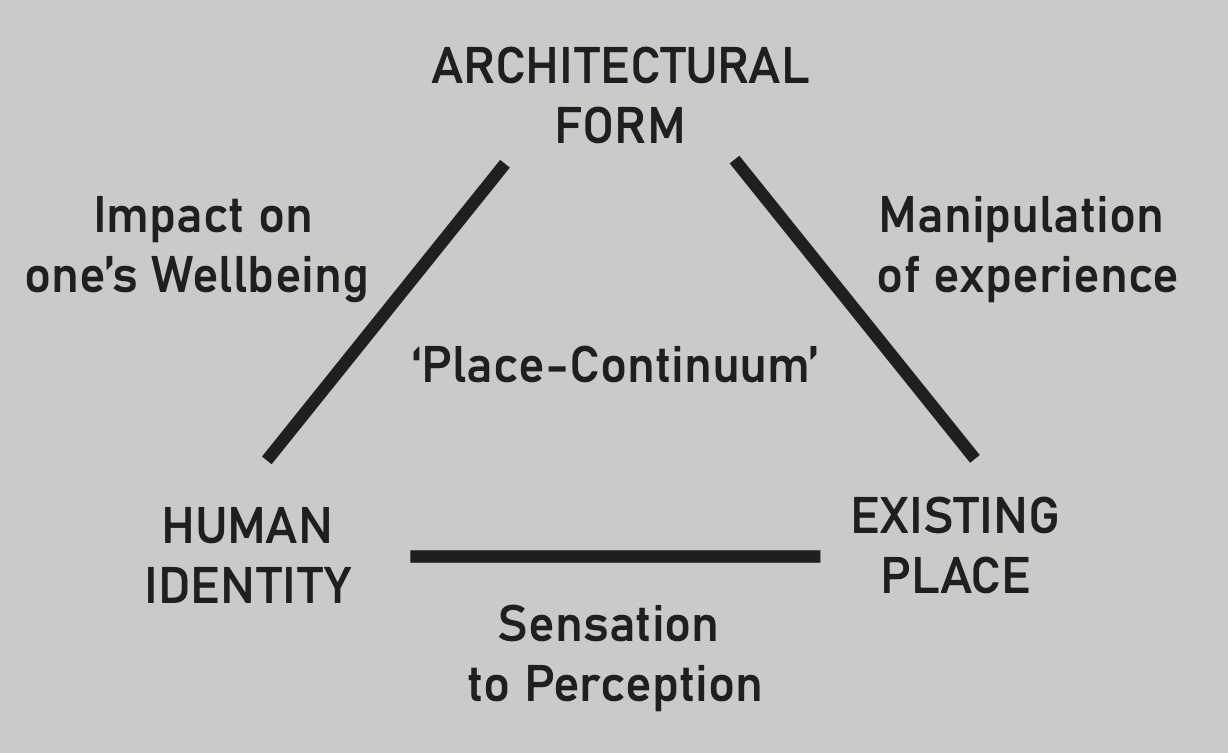
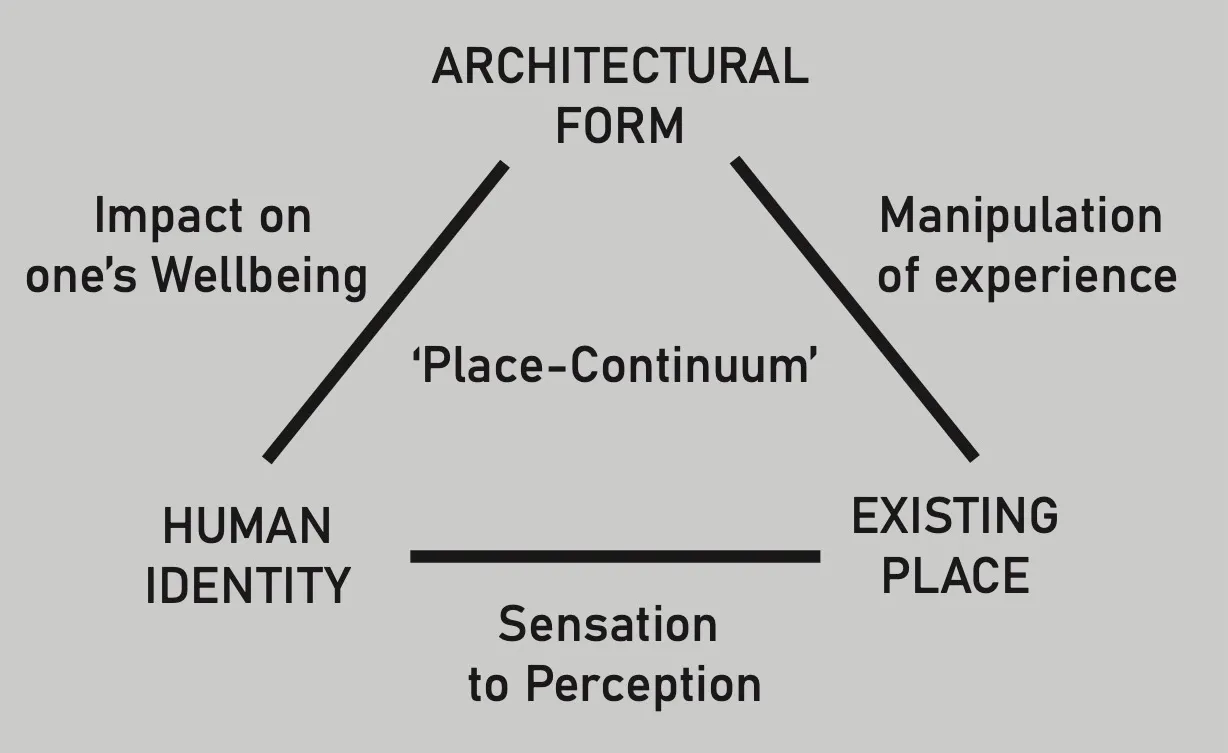
The problem with that scenographic approach has led to context-less environments propelling conditions of urbanisation like suburban sprawl and the removal of one’s association with the natural world. This brings me back to a framework for design that I developed in my final undergraduate year (Bachelor of Architectural Studies). Place-continuum examines an exploration of cohesion between three concepts, Existing Place, Architectural Form, and Human Identity and discusses the ways they intersect.
This ideology was devised as a response to my enquiry into how the understanding of Place as a conceptual belief informs architecture. My aim was to propose a method to instigate my design response that acknowledged history, associations that people had to existing places and how new architecture cannot erase but offer a continuation of that embodied experience.
This was not an attempt to explore and manipulate experience of place into an architectural form (akin to ‘Place-making’), but rather I looked to a concept of ‘Place-continuing’, in order to invite an expression of characteristics of the past while embracing the future.
Establishing this conceptual framework allowed me to consolidate my theoretical understanding of architecture as a student, but as I reflect on it now that I am in practice, I can’t help but wonder — how do I preserve my connection with this concept of ‘place-continuum’?
In my brief time working as an architectural technician, I’ve had the chance to work on a variety of projects, from small-scale commercial con struction to planned residential additions and new homes. This has helped me advance my technical education and cultivate a more practical mindset that prioritises client goals and budget. However now that I’m practicing, I notice that I’m progressively drifting away from my philosophy; ‘place-continuum’ seems more like an idealistic, theoretical afterthought in the realities of architectural practice with all its complexities and constraints.
How has being in practice affected my creative agility? The first thing I learned as a student was to prioritise a critical engagement with a site (culturally, socially and historically) through a range of design processes (like site analysis diagramming and massing models.)
The efficiencies of digital resources have gone some way to disrupt this connection to land as an embodied experience. Instead, there is often little need to visit a site at all, as most work can be carried out in the office through various digital programming tools.
Research that was so drummed into us as students has been reduced to identifying potential risk factors and policy-based parameters. Or perhaps it is my lack of critical enquiry outside of my day job — lack of engagement in creating, questioning. The omission of both 2D and 3D exploration. Instead, I intellectualise digital media, searching for evidence of ‘place continuum’ in architectural blogs, questioning if the projects on my screen have been instigated through connection to a physical experience. Or, am I viewing a constructed reality?
WHAT HAS BEEN…
In ‘The Aesthetic in Place,’ Arnold Berleant establishes place as a structure of qualities for a person’s engagement with the revolving world. These concrete characteristics are explored through physical identity, coherence, and meaning.
Identity conveys a sense of place through one’s ability to orientate themselves within topographical features or centres. Establishing a sense of place through physical coherence is explored through architectural similarity or being bounded by an interior space or urban square. Meaning distinguishes itself by existing as an interaction of human sensibility towards a place.
Combinations of these elements contributes to a distinctive presence of place.(1) Context is not implied to suggest a single landscape, but rather a formulation of surrounding community and locality. This is not to say design a building like the one adjacent to site, but to illustrate the importance of awareness towards local materiality and craftmanship.
..WHAT COMES NEXT?
As I navigate through the fast-paced world of construction, I am constantly reminded of the importance of efficiency and meeting deadlines. While I strive to uphold my philosophy of ‘place-continuum,’ I also understand the necessity of adapting to the demands of the industry. Finding a balance between the two will be a challenge, but I am committed to maintaining my client-centered approach while staying abreast of technological advancements in the field. Ultimately, it is about finding a way to merge the old with the new, in order to create successful and satisfying projects for my clients and myself.
If successful, I think the application and materialisation of ‘place-continuum’ holds the potential for designers to contribute to our built environment more authentically… …more conscious of the unity between a sustained scene and witness. Place-continuum illustrates that place is a multilayered condition able to adapt and absorb past, present and future ideologies.
This is not fixing time architecturally through pseudo representational techniques such as nostalgic or ‘character styles’ but rather presenting architecture that reflects this time, these people, this history and this land.
Architecture that responds, restores, and continues an aesthetic and experiential sense of place, creating re-engagement between form and nature, as well as human engagement, is essential. The advancement and application of both science and technology within construction should look to enhance the connection made to place and human identity.
ENDNOTES
1 Arnold Berleant, “The Aesthetic in Place,” in Constructing Place: Mind and Matter, ed. Sarah Menin (London: Routledge, 2003), 43.